What is Vibe Coding? The Beginner's Guide to Building with AI
You've seen the term everywhere. Someone on X ships an app in a weekend. No CS degree. No Stack Overflow. Just prompts and vibes. That's vibe coding.
Vibe coding is a style of software development where you describe what you want to build in plain English, and an AI model writes the code for you. Instead of writing syntax, you direct the AI through prompts, iterating until the product works the way you envisioned it.
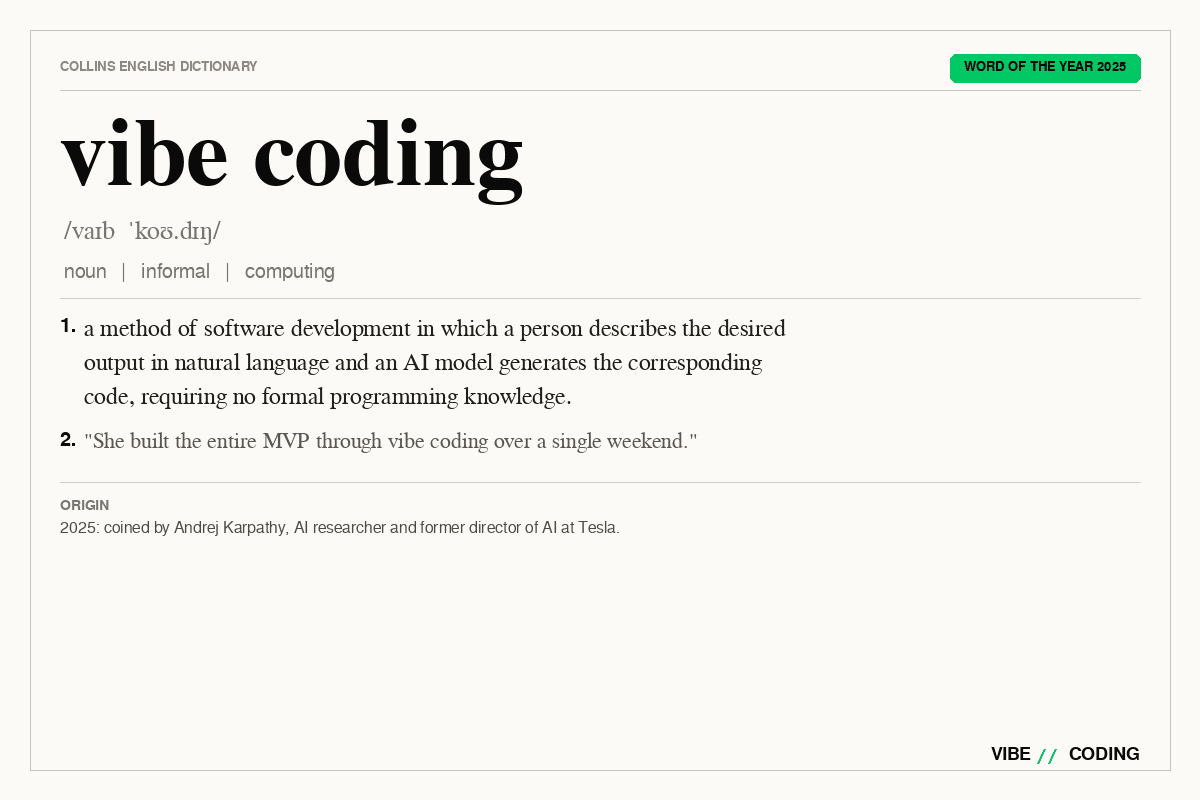
AI researcher Andrej Karpathy coined the term in early 2025, and it caught on fast. Collins Dictionary named it Word of the Year 2025. In the 12 months that followed, monthly searches for "vibe coding" grew over 66,000%. This is not a niche trend.
This guide covers what vibe coding actually means, where it came from, how it works step by step, the best tools to use in 2026, who it's for, and what the honest tradeoffs are.
Andrej Karpathy, former director of AI at Tesla and one of the founding members of OpenAI, introduced the term "vibe coding" in a post on X in early 2025.
His framing was disarmingly simple: instead of fighting the AI or carefully reviewing every line it writes, you surrender to it. You describe what you want, accept what it produces, and keep prompting until it works. The vibe is the direction. The AI handles the rest.
The Rick Rubin comparison showed up almost immediately in tech circles, and it fits. Rubin doesn't play instruments. He doesn't engineer tracks. He creates the conditions for great music to happen by setting the vision and reacting to what he hears. Vibe coders do the same thing with software.
Collins Dictionary making it Word of the Year 2025 matters for one reason: it signals that this is not jargon that will fade. It's entered the mainstream vocabulary. That's a different kind of staying power.
The gap between traditional coding and vibe coding is not just about tools. It's about what skill is doing the work.
Traditional Coding | Vibe Coding | |
|---|---|---|
Input | Syntax, logic, frameworks | Plain English prompts |
Skill required | Programming languages | Clarity of thinking |
Speed | Weeks to months | Hours to days |
Output quality | Developer-controlled | AI-generated, human-directed |
Best for | Complex systems, scale | MVPs, prototypes, founders |
This question comes up constantly, especially from developers and CS students. The honest answer: it depends on what you think coding is for.
If the goal is to learn how computers work at a deep level, then yes, outsourcing that to an AI skips the education. A student using Cursor to write their algorithms homework is cheating themselves out of the understanding they're supposedly there to build.
But if the goal is to ship a product, solve a problem, or test an idea, then using the best available tool is just competent execution. A contractor who uses a nail gun instead of a hammer is not cheating. They're building faster.
The "is vibe coding bad" framing usually comes from confusing these two contexts. Vibe coding is a bad way to learn computer science fundamentals. It's a very good way to build a working prototype in a weekend.
The process is more structured than it looks from the outside. Here's the practical flow for a beginner:
The single biggest mistake beginners make is starting with a vague prompt. "Build me an app" produces garbage. "Build me a web app where users can input a URL and get a plain-text summary of the page content" produces something useful.
Before you open any tool, write one paragraph describing exactly what you want to build. Who uses it. What it does. What it outputs. The quality of your prompt determines the quality of what you get.
Different tools suit different use cases. Cursor is built for developers who want AI deeply integrated into a real code editor. Lovable and Bolt are better for non-technical founders who want a working app without touching a codebase directly. Pick based on your comfort level and what you're building. (Full tool breakdowns are in the next section.)
Don't try to build everything in one prompt. Start with the core feature. Get that working. Then add the next layer. Think of it like a conversation, not a specification document. You're directing, the AI is building, and each round gets you closer to what you actually want.
When something breaks, don't try to read the code and fix it yourself. Copy the error message, paste it back into the chat, and describe what you expected to happen instead. "I got this error when I clicked the submit button. It should have saved the form data and redirected to the dashboard." The AI will debug it.
Vibe coding rewards speed over perfection. Get to a working version, put it in front of real users, and use their feedback to drive the next round of prompts. The goal is a functional MVP, not clean code. You can refactor later. Or not at all, if it works.
The tool you choose changes the experience significantly. Here's a quick breakdown of the leading platforms. Each one has a dedicated review on this site with setup guides and real use cases.
Cursor An AI-powered code editor built on VS Code. Cursor is the go-to for developers who already know how to code and want to move faster. It reads your entire codebase and generates code that fits your existing patterns. Best for: developers, technical founders.
Lovable A full-stack app builder that generates production-ready apps from plain-English prompts. No setup, no local environment. You describe the app, Lovable builds it, and you can deploy in the same session. Best for: non-technical founders, marketers building internal tools.
Bolt Fast prototyping built on Stackblitz. Bolt is similar to Lovable but skews more toward quick UI experiments and front-end builds. Best for: rapid prototyping, front-end projects.
Replit Browser-based coding environment with AI built in. Replit is arguably the most beginner-friendly entry point to vibe coding because you don't install anything. Everything runs in the browser. Best for: beginners, students, quick experiments.
v0 by Vercel Generates UI components from prompts, built specifically for React and Tailwind. If you're building a web app and need a polished front end without designing it from scratch, v0 is the fastest path. Best for: UI generation, front-end components.
Google AI Studio Gemini-powered environment for experimenting with prompts and building lightweight AI-native apps. Less structured than the others, but powerful for founders exploring what's possible. Best for: AI experimentation, prompt development.
Productivity is essential for creative freelancers who want to grow in a competitive market. Smart routines, helpful tools, and healthy habits make work more organized and enjoyable.
By improving focus and structure, freelancers can deliver better outcomes and take on new opportunities with confidence. Productivity is not just about doing more. It is about working smarter and creating a sustainable path for long term success.
The short answer is: more people than you'd think.
Founders and solopreneurs This is the primary audience. If you have a product idea and no technical co-founder, vibe coding closes that gap. You won't build a production-scale SaaS in a weekend, but you will build something you can put in front of users and validate. That's the part that matters at stage zero.
Marketers and operators Vibe coding is changing what non-technical people can build internally. Automated reports, custom dashboards, lightweight tools that pull data from an API, internal Slack bots. These used to require a developer. Now they require a clear prompt and an afternoon.
Traditional developers Experienced engineers are using vibe coding tools to handle boilerplate, generate test coverage, prototype features faster, and offload repetitive work. The developers who are threatened by these tools are the ones treating them as competitors. The ones winning are treating them as a 10x multiplier on their existing output.
What about vibe coding jobs?
Searches for "vibe coding jobs" are growing, which means people are trying to build careers around this. The realistic picture: vibe coding is becoming a required skill layer on top of existing roles, not a standalone job title yet. The founder who can vibe code ships faster. The marketer who can vibe code builds tools their competitors can't. That's the career play for now.
Pros:
Speed to prototype is dramatically faster than traditional development
No CS degree or programming background required to get started
Lower cost to test ideas before committing to a full build
Democratizes building for anyone with a clear idea and a good prompt
Cons:
AI-generated code can contain security vulnerabilities if left unreviewed
Debugging complex outputs is hard when you don't understand the underlying code
Not suited for large-scale production systems without engineering oversight
You're dependent on third-party tools and their pricing, uptime, and roadmaps
The honest framing: vibe coding is a powerful way to go from zero to something real, fast. The risk is in treating "something real" as "production-ready" without the review to back it up. At MVP stage, that tradeoff is usually worth it. At scale, you need engineers who understand what was actually built.
The trajectory is clear: the gap between "I have an idea" and "I have a working product" is going to keep shrinking. Tools are getting better at handling complexity, catching their own errors, and maintaining consistency across larger codebases.
What won't change is the value of clear thinking. The best vibe coders are not the ones who know the most prompt tricks. They're the ones who can describe exactly what they want with precision. That's a communications skill and a product thinking skill. Both are learnable.
The bigger question is not whether vibe coding will stick around. It will. The question is who builds the habits and community around it while it's still early. That's the window that's open right now.
We cover what's actually working in AI-native building every week on the Builder's Growth Lab podcast, with real founders, real tools, and zero hype.
What does vibe coding mean? Vibe coding means building software by describing what you want in plain English and letting an AI write the code. The "vibe" refers to the intention and direction you bring. The AI handles the syntax.
Who invented vibe coding? Andrej Karpathy coined the term in early 2025. Karpathy is an AI researcher who was previously director of AI at Tesla and a founding member of OpenAI.
Is vibe coding cheating? It depends on the context. For a student trying to learn programming fundamentals, yes, it shortcuts the learning. For a founder trying to ship a product, it's just using the best available tool. The goal determines whether it's cheating.
Can I get a job with vibe coding? Not as a standalone skill yet, but it's increasingly valuable as an addition to existing roles. Founders, marketers, and operators who can build tools using AI are getting more done than those who can't. The career advantage is real. A dedicated "vibe coder" job title is still emerging.
What's the difference between vibe coding and no-code? No-code tools like Webflow or Airtable use visual interfaces and pre-built logic. Vibe coding uses AI to generate actual code from natural language. Vibe coding is more flexible and can build more complex products, but it has a steeper learning curve than drag-and-drop no-code tools.
What are the best free vibe coding tools? Three good starting points with free tiers: Replit (browser-based, great for beginners), Google AI Studio (Gemini-powered, strong for AI experimentation), and v0 by Vercel (UI component generation). Cursor, Lovable, and Bolt all have free tiers with usage limits.